Contingency planning for food security and biodiversity
During our project lifecycle, we will conduct consumer behaviour studies to test and implement behavioural interventions (such as nudges and behavioural vaccines) that can potentially bring positive change to biodiversity relevant behaviours. We will identify relevant behavioural change interventions with the aim to nudge citizens to adapt consumption habits that affect food security, climate change and other relevant environmental targets related with biodiversity.

Planning for contingencies
In a contingency situation, the ability for swift action that limits the negative consequences of emerging contingency situations is dependent on preparation and planning. This involves not just the identification of potential hazards that could create contingency situations for producers and/or consumers but the identification of activities that could help reducing the negative effects of potential hazards and of actors that could initiate the activities on short notice in times of need.
Agriculture and risks
Agriculture and the food system have to deal constantly with risks which may create problems in food security, in biodiversity or the economic performance of the food system actors. The dependency of ‘open field’ agriculture on weather conditions, pests and plant diseases or the dependency of animal production on health conditions not only in the farm environment but in regional developments are constant sources of potential production failures, threatening farm survival, food security, and biodiversity.


Getting prepared
For mitigating the effects of emerging hazards, contingency planning could identify and organize suitable activities of actors with influence on the food system. With the many actors engaged in the food system, this is a difficult task as it does not only involve the identification of suitable actors with the activities but clarifying costs, availability of activities on short notice, the clarification of competences in initiating activities, the agreement on an “initiator”, and a clarification of the feasibility of a plan in a contingency situation on short notice. The clarification of a feasibility requires simulation of contingency situations with the engagement of all potential actors on a regular basis for assuring feasibility in times of need.
The concept
Complexity in planning support
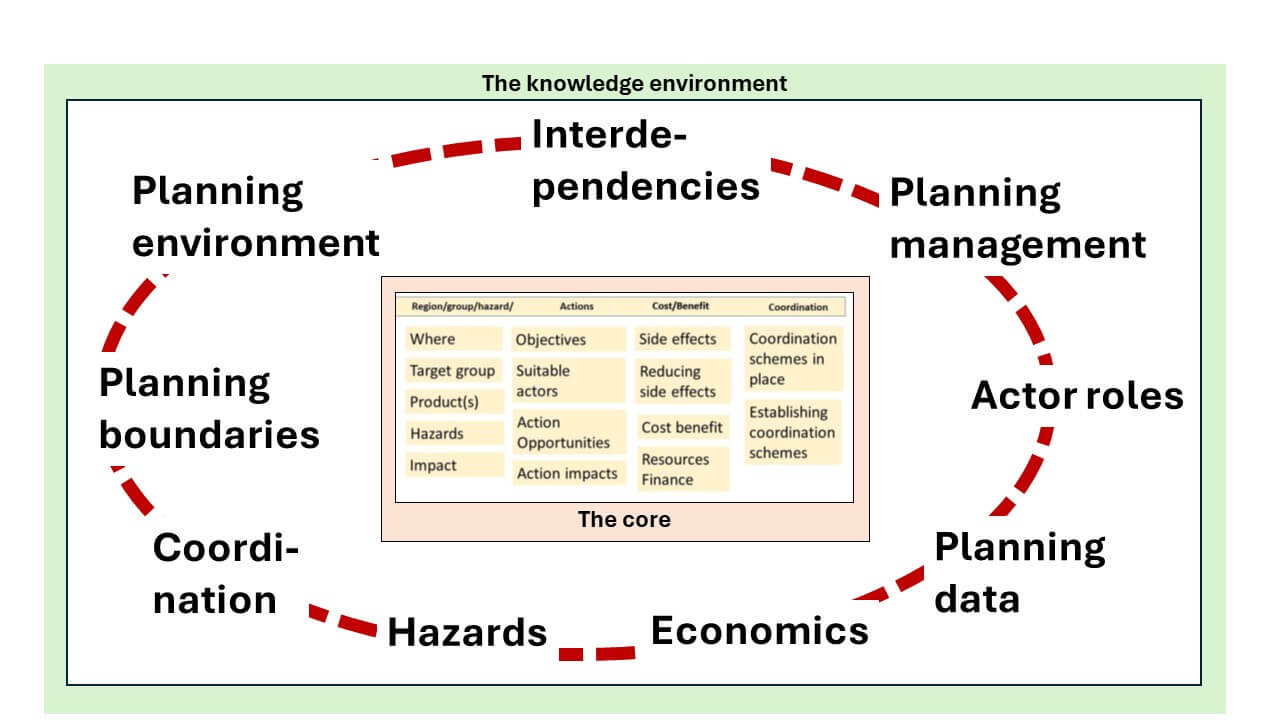
Contingency planning is a most complex planning activity as it has to deal with a fuzzy future we know little about and results have to work in a real future which is different than expected. For assuring the feasibility of a contingency plan even in futures not completely envisaged before, the planning process needs to be transparent and documented on all stages, allowing an adaption to newly emerging futures on all process stages on short notice.
Approach for planning support
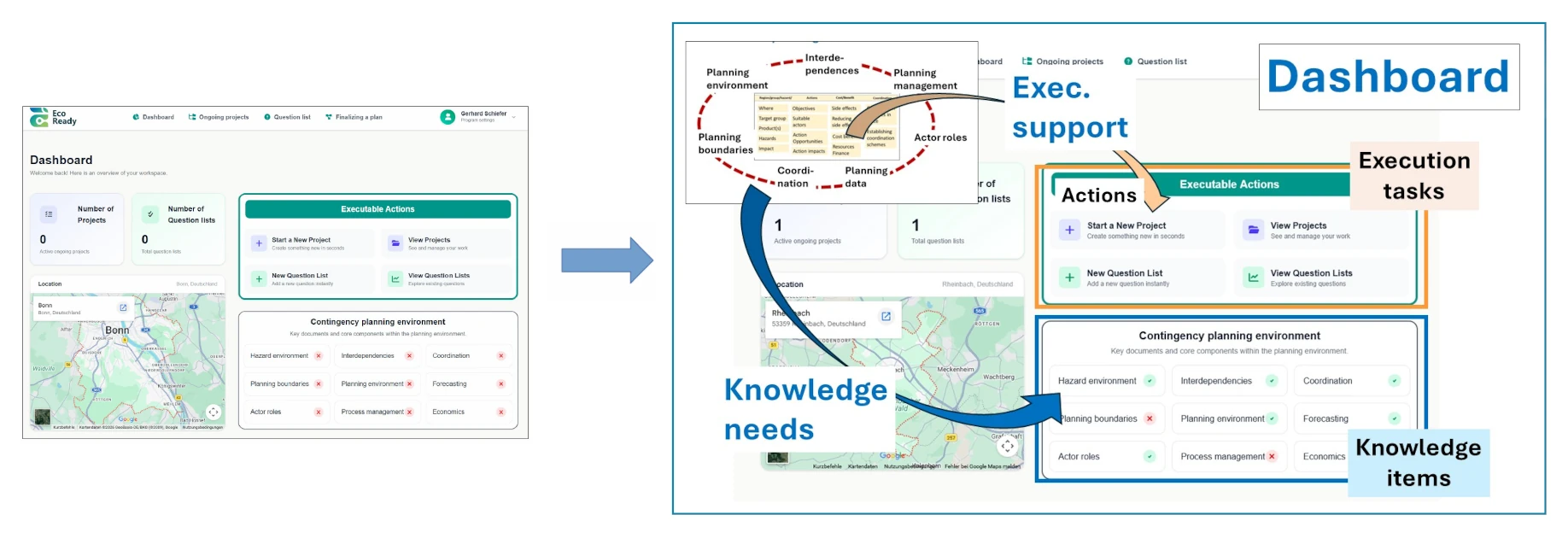
Planning depends on available expertise, competence in organization, and support in a stepwise planning process leading from situation analysis to a concrete activity guide. The core planning process building on a stepwise development of a contingency plan needs to be embedded in a broad knowledge environment provided by experts in the field. As a consequence, any tool provided for planning support cannot succeed in developing sensible contingency plans if not combined with access to the knowledge environment.
Transformation of concept into tool: the dashboard
Access to tool
www.eco-cp.eu
or through the website of Eco-ready.
Example draft applications
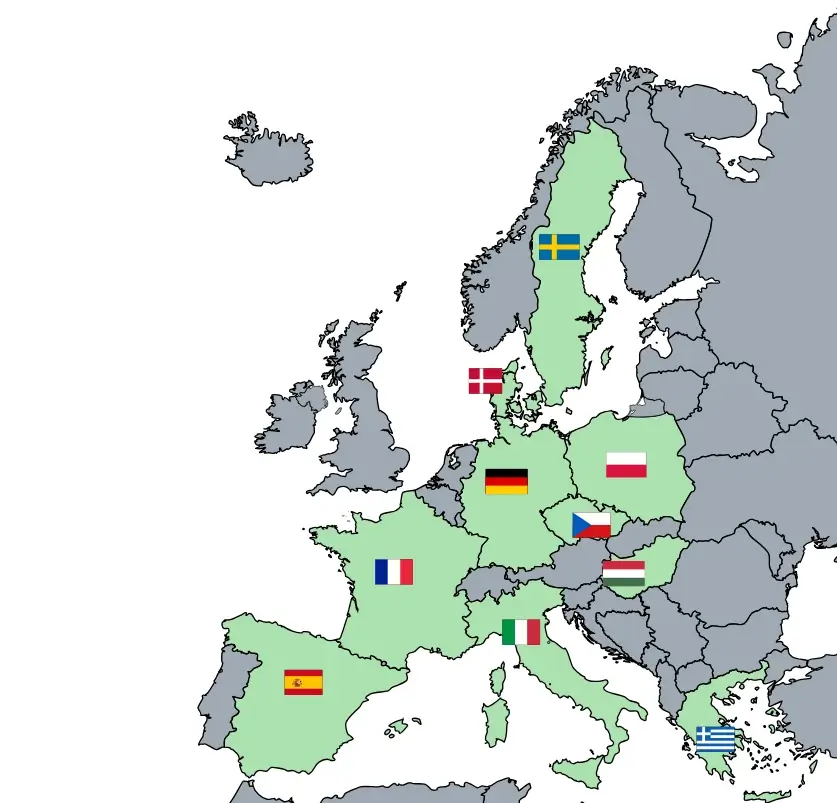
Case study Sweden : The case study concerns a contingency planning effort for a limited market such as a market for leafy greens and herbs in Sweden. Efforts are focused primarily on vertical farms but with a view on consumption effects.
Case study Spain : This report concentrates on contingency planning in the Spanish region Catalonia with a primary view on Olive growing farms and the challenges they face due to experiences of drought and water shortages which might be linked to changes in climate. It is expected that in future scenarios the shortage of water will be a constant and increasing phenomena which requires action in support of farms, the region, and in consequence, the health of the people, the cultural identity of the region, and the wealth of its population.
Case study Italy : This report concentrates on contingency planning in the Italian region Basilicata with a primary view on contingencies in tomato and olive production that may arise from climate developments leading to increased drought.
Case study Poland : This report concentrates on contingency planning in the Polish region Masuria with a primary view on contingencies that may arise from diseases in milk cows such as foot-and-mouth disease and the pressing problem of demographics with young people leaving agriculture.
Case study Czech Republic : This report concentrates on contingency planning in the Czech Republic with a primary view on contingencies that may arise from climate change leading to increased drought.
Case study Greece : This report concentrates on contingency planning in the Greek Central Region with a primary view on contingencies that may arise from climate developments leading to increased wildfires and drought.